
Why “Download the App” Wasn’t Enough: A Conversion Investigation for a Fortune 500 Financial Institution
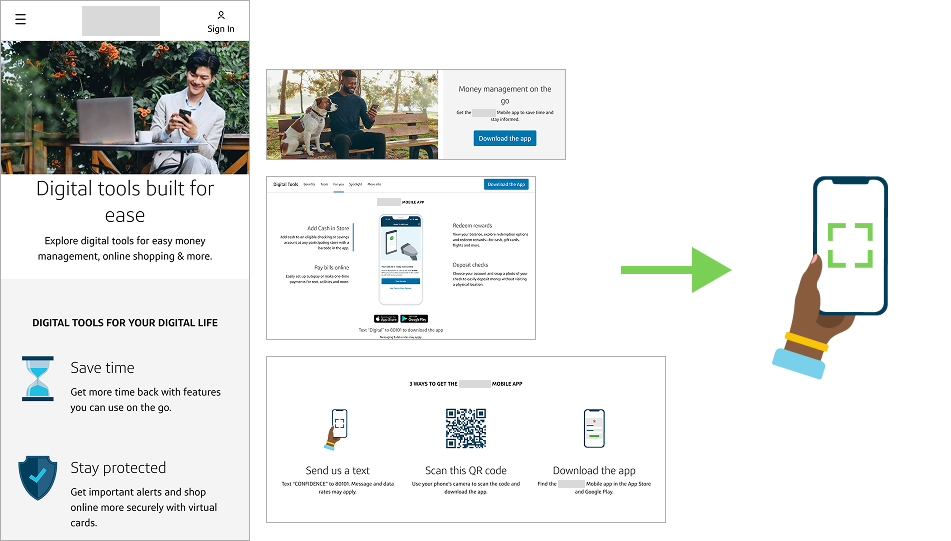
- Client: Fortune 500 Financial Institution | Digital Tools Department
- Role: CRO Strategist & UX Lead
- Collaborators: UX Designer, SEO, Content
- Timeline: Q2 2026
The Problem
A Fortune 500 financial institution’s Digital Tools team had a mystery on their hands. Some “Download the App” CTAs converted well. Others were ignored entirely. I led this engagement with another UX designer, partnering with SEO and Content teams to trace the full journey from landing page to app store download and figure out why.
My Approach
Instead of starting with a fix, I started with the journey itself, mapping which pages most influenced download behavior and layering two research methods on top of that map. User interviews with customers unfamiliar with the app let us watch, in real time, what confused or stalled them as they moved through blog content and landing pages. A parallel data analysis filled in the behavioral picture. We didn’t have direct access to the client’s primary analytics platform, so we partnered with SEO to reconstruct page views, drop-off, and CTA engagement from the sources we could reach.
The Finding
Users weren’t ignoring the CTAs because they didn’t want the app. They already knew it existed. The copy around it just gave them no reason to switch from habits they trusted, no clear value proposition, no friction reduction, no trust-building. It was a motivation problem, not an awareness one.
The Results
18 recommendations across four categories, CTA visibility, message-intent alignment, trust and friction reduction, and incentive framing, organized into a prioritization matrix so the client could sequence quick wins against changes that needed testing first.
What I’d change next time
Two lessons stuck with me. I’d restructure the final presentation to lead with prioritization instead of ending with it; we ran out of time before walking through the matrix live, and the client left without a clear starting point. And I’d bring in AI to run a first pass on the messy behavioral data before the team invested manual hours reconstructing it by hand.